Innovation
As an Assistant Medical Officer in Orthopaedics, I teach in a uniquely rich clinical environment — every procedure, every operation, every wound dressing is an invaluable learning opportunity. Teaching in orthopaedics is not just theory in a lecture hall — it takes place in the operating theatre, treatment rooms, and at the patient’s bedside.
The following accounts for some of the innovations I practice in Orthopaedics.
Every orthopaedic procedure I perform becomes a live-teaching session for house officers and medical students. Procedures include:
I teach using the principle "See one, Do one, Teach one" — a classic medical education method effective for building procedural clinical skills.
Target groups:
The operating theatre (OT) is one of the richest teaching spaces in medicine. While assisting in the OT, I actively:
“The operation is a silent but powerful lecture — every cut teaches, every suture speaks.”
I introduced a systematic approach to teaching orthopaedic wound assessment — teaching students to use an easy-to-remember framework:
The table above reflects the TIME Principle, a reference for wound assessment. I prepared a TIME Principle poster as a teaching aid during active clinics to enable early diagnosis and wound-type identification. This approach teaches students that orthopaedic wound assessment is both a science and an art — requiring a trained eye and deep clinical judgment.
I organise informal demonstrations of POP application for new house officers and medical students — teaching correct techniques for:
This is important because incorrect POP technique can cause serious complications such as compartment syndrome, pressure sores, and malunion.
Based on my Master’s research on Entrustable Professional Activities (EPAs), I began applying an EPA framework to assess orthopaedic learner skills:
This framework gives learners a clear skills map — they know what to achieve and at what level they currently perform.
Structured competency assessment
1–2
years
Safe hands-on practice without patient risk
2–3
years
Documentation of clinical progress
1–2
years
Foster a culture of evidence-based practice
Immediate
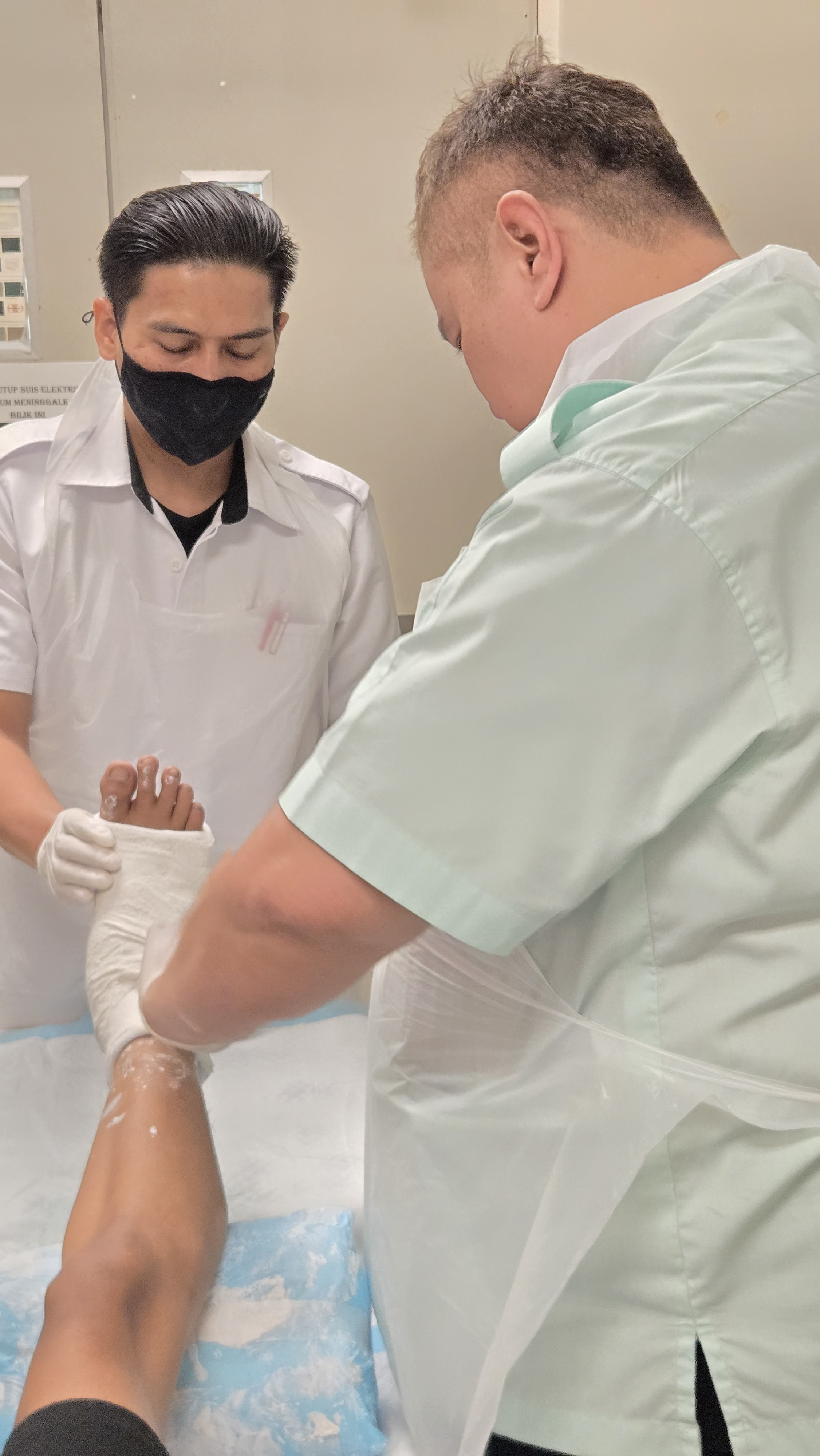
I believe every dressed wound, every POP applied, every OT procedure assisted — is an opportunity to illuminate students’ minds with knowledge and skills they will use throughout their careers. My greatest innovation is not advanced technology, but my commitment to make every clinical moment a meaningful teaching opportunity.